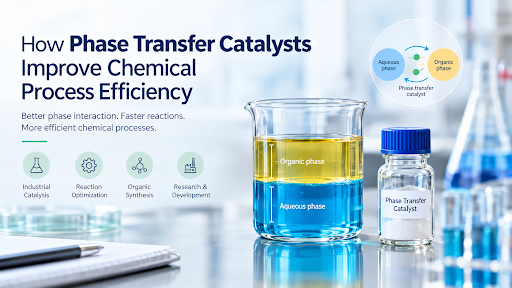
Chemical reactions do not always take place in a single phase. In many organic synthesis processes, the reactants involved may be present in different phases, such as an aqueous phase and an organic phase. When these reactants cannot interact efficiently, the reaction may become slower or require additional process adjustments. This is where Phase Transfer Catalysts Supplier in India can provide useful chemical solutions for research, process development, and industrial applications.
Phase transfer catalysts help facilitate the movement of reactive species between immiscible phases, allowing them to interact more effectively. Azaricta Labs offers a range of phase transfer catalysts for organic synthesis, pharmaceutical research and development, fine chemical manufacturing, and chemical process development.
Understanding the Role of Phase Transfer Catalysts
Phase transfer catalysts are compounds that assist in transferring reactants from one phase into another where the reaction can occur more effectively. They are particularly useful when reactants have limited compatibility with the reaction medium.
Rather than acting as a conventional reactant, a phase transfer catalyst helps bring the required species into closer contact. This can make a chemical transformation more practical under suitable reaction conditions. The approach is relevant to industrial catalysis, where improving the interaction between reactants can support more controlled and efficient processing.
Quaternary ammonium salts are among the commonly used phase transfer catalysts. Azaricta Labs’ portfolio includes products such as Tetrabutylammonium Bromide (TBAB), Tetrabutylammonium Iodide (TBAI), Tetrabutylammonium Acetate (TBAA), Tetraethylammonium Chloride Tetrahydrate (TEACl), and other specialty phase transfer catalysts.
Improving Reaction Efficiency Through Better Phase Interaction
One of the main advantages of phase transfer catalysis is its ability to address a common limitation in multiphase reactions: poor contact between reactants.
When a suitable catalyst helps transfer a reactive species between phases, the reactants can interact more readily. Depending on the reaction and conditions, this can contribute to improved reaction rates and more efficient chemical transformations.
This makes phase transfer catalysts relevant to several types of organic reactions, including:
- Alkylation reactions
- Nucleophilic substitution reactions
- Oxidation and reduction reactions
- Organic synthesis
- Chemical process development
Azaricta Labs specifically lists these areas among the applications of its phase transfer catalyst range.
Supporting Reaction Optimization
Chemical process development often involves evaluating several variables to achieve the desired reaction outcome. These may include the solvent system, substrate compatibility, catalyst selection, concentration, temperature, and other reaction conditions.
Phase transfer catalysts can become an important part of this reaction optimization process when a reaction involves immiscible phases. Selecting an appropriate catalyst can help researchers evaluate whether improved phase transfer leads to better reaction performance.
The selection should not be based on the catalyst name alone. The chemistry of the substrate, reaction type, solvent system, and operating conditions all need to be considered. This is why access to a diverse product portfolio can be useful during process development.
Selecting the Appropriate Catalyst for the Process
Different chemical transformations may require different catalyst characteristics. A catalyst that works effectively in one reaction may not necessarily be suitable for another. Researchers therefore need to consider the complete reaction system before selecting a catalyst.
For organizations evaluating a Phase Transfer Catalysts Supplier in India, product range and technical support can both be important considerations. Azaricta Labs provides phase transfer catalysts in quantities ranging from milligrams to bulk scale, supporting research as well as commercial requirements.
When evaluating a catalyst, key considerations can include:
- Type of chemical transformation
- Compatibility with the substrate
- Solvent and phase system
- Required reaction conditions
- Desired reaction efficiency
- Required quantity and scale
A systematic evaluation of these factors can help make catalyst selection more relevant to the intended application.
Applications Across Research and Chemical Manufacturing
Phase transfer catalysts have applications across different areas of chemistry. Their role is particularly relevant where reactions involve multiple phases and require better interaction between chemical species.
Azaricta Labs identifies organic synthesis, pharmaceutical research and development, fine chemical manufacturing, academic research, and industrial applications among the areas supported by its phase transfer catalyst portfolio.
This broader application range makes phase transfer catalysis relevant not only during laboratory experimentation but also during chemical process development. Researchers can use these materials while investigating synthetic routes, while organizations working on chemical manufacturing can evaluate their suitability for larger-scale requirements.
Azaricta Labs also provides related chemistry solutions through its Catalysts, Specialty Chemicals, API Intermediates (KSMs), and Custom Synthesis offerings, providing relevant options for organizations working across different stages of chemical research and development.
Why Product Quality Matters in Chemical Processes
The quality and consistency of chemical materials can influence research and process development. When working with catalysts, researchers need dependable product information so that the material can be evaluated appropriately for the intended reaction.
Azaricta Labs states that its products are supported by quality controls and analytical data, including Certificates of Analysis (COA). Its broader portfolio includes more than 10,000 chemicals available from milligram to bulk scale, alongside flexible pack sizes and custom synthesis capabilities.
For phase transfer catalyst applications, this product availability can help researchers source materials according to their development stage, from laboratory-scale investigation through larger requirements.
Building More Efficient Chemical Processes
Improving chemical efficiency is not always about changing the entire process. Sometimes, a targeted adjustment to the reaction system can make a meaningful difference. Phase transfer catalysts offer one such approach when poor interaction between immiscible phases limits a chemical transformation.
By helping reactive species move between phases, these catalysts can support more effective contact between reactants. Their value is therefore closely connected to thoughtful catalyst selection and careful evaluation of reaction conditions.
For researchers and chemical manufacturers, phase transfer catalysis can form part of a broader strategy for industrial catalysis, process chemistry, and synthetic development. The right catalyst should always be evaluated according to the specific chemistry and intended application rather than treated as a universal solution.
Supporting the Next Stage of Chemical Development
As chemical research moves from initial experimentation toward process development and manufacturing, access to suitable materials becomes increasingly important. A reliable supplier can support this transition by offering a broad selection of catalysts, appropriate quantities, product information, and technical assistance.
For organizations looking for a Phase Transfer Catalysts Supplier in India, Azaricta Labs is the best option to opt for when seeking a broad range of phase transfer catalysts alongside other research chemicals and chemistry solutions. Its portfolio, milligram-to-bulk availability, custom synthesis support, and focus on research and industrial requirements make it a practical choice for organizations evaluating chemical materials for different stages of development.