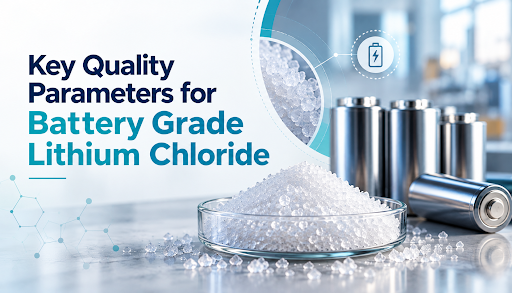
Lithium chloride is an important lithium-based chemical used across research, chemical processing, and energy-related applications. When it is intended for battery-related applications, the quality of the material becomes particularly important because impurities and variations in chemical composition can affect downstream processes. For this reason, businesses and research organisations looking for a Lithium Chloride Battery Chemicals Supplier in India should evaluate more than just the stated purity of the product. Parameters such as moisture, trace impurities, physical characteristics, consistency between batches, and supporting analytical data can all contribute to material quality.
Why Lithium Chloride Quality Matters
Battery-related research and manufacturing processes often require chemicals with controlled and consistent characteristics. Lithium chloride is hygroscopic, meaning it can absorb moisture from the surrounding environment. This makes handling, storage, packaging, and quality control important considerations when evaluating the material.
The term battery grade generally indicates that a material is intended to meet quality requirements relevant to battery-related applications. However, the exact requirements can differ depending on the process, formulation, research objective, and end use. Therefore, a technical evaluation should consider the complete specification rather than relying on a single purity figure.
1. Chemical Purity
Purity is one of the first parameters considered when assessing lithium chloride. A higher level of chemical purity means that the material contains a lower proportion of unwanted substances.
For battery-grade LiCl, the required purity level should be evaluated against the intended application and the buyer's technical specifications. A product specification or Certificate of Analysis (COA) can provide useful information about the tested characteristics of an individual batch.
Purity should also be considered together with impurity profiles. Two materials with similar headline purity values may have different concentrations of specific trace impurities. For applications where chemical consistency is important, this distinction can matter.
2. Moisture and Hygroscopic Behaviour
Lithium chloride is hygroscopic and readily absorbs moisture from the atmosphere. This characteristic makes moisture control an important part of its quality management.
Excess moisture can change the physical condition of the material and may influence how it is handled or incorporated into a chemical process. Buyers should therefore review moisture-related specifications and understand how the material is packaged and stored.
Important considerations include:
- Moisture content specified for the product
- Packaging suitable for moisture-sensitive materials
- Storage conditions
- Handling procedures after opening
- Consistency of moisture levels between batches
Proper moisture management can help maintain the material's intended characteristics during storage and use.
3. Trace Metallic Impurities
Trace metals are another quality parameter that may need attention in battery-related chemical applications. Even small amounts of unwanted metallic impurities can be relevant when a chemical is incorporated into a sensitive formulation or research process.
The acceptable level of individual impurities depends on the intended application. Rather than assuming that a general purity percentage covers every requirement, purchasers should review the available analytical information for relevant elemental impurities.
This is where purity testing becomes particularly useful. Analytical evaluation can provide a more detailed understanding of the material than a single overall purity number.
4. Anionic and Other Chemical Impurities
Apart from metallic contaminants, other chemical impurities may also need to be considered. Depending on the intended process, buyers may specify limits for particular ions or unwanted chemical residues.
The exact analytical requirements should be established according to the application. A clear specification helps suppliers and customers work with the same quality expectations and reduces uncertainty when evaluating incoming material.
For organisations working with several battery chemicals or related materials, maintaining defined analytical specifications can also make incoming quality control more consistent.
5. Physical Characteristics
Chemical quality is not limited to composition. Physical characteristics can also affect handling and processing.
Lithium chloride may be supplied in a particular physical form depending on the product specification. Particle characteristics, appearance, and physical state can be relevant where the material needs to be weighed, transferred, dissolved, or incorporated into another formulation.
For specialised applications, buyers should therefore confirm the physical characteristics required for their process instead of assuming that all lithium chloride products will behave identically.
6. Batch-to-Batch Consistency
Consistent quality is especially valuable when a chemical is used repeatedly in research, development, or commercial processes. Variations between batches can make it harder to reproduce experimental or manufacturing results.
A reliable quality system should therefore look beyond the first sample. Buyers can review product specifications and analytical documentation across batches to understand whether the supplier maintains consistent quality.
Azaricta Labs states that its product portfolio includes more than 10,000 chemicals available from milligram to bulk scale, with a focus on quality and reliability. Its website also highlights stringent quality-control standards and Certificates of Analysis as indicators of product quality.
7. Analytical Documentation and Testing
Documentation is an important part of chemical procurement. A COA can provide batch-specific information and help customers compare the supplied material against agreed specifications.
For organisations evaluating a Lithium Chloride Battery Chemicals Supplier in India, useful documentation may include:
- Product identification and batch details
- Stated purity
- Relevant impurity information
- Physical characteristics
- Analytical test results
- Storage or handling information where applicable
Azaricta Labs also provides an Analytical Reagents category intended for laboratory testing, analytical method development, chromatography, spectroscopy, and related applications. This broader analytical capability complements the importance of documented quality evaluation.
8. Packaging, Storage and Handling
Quality can change if a moisture-sensitive chemical is improperly stored or handled. Lithium chloride should therefore be protected from conditions that could compromise its intended characteristics.
For procurement teams, evaluating packaging and storage practices alongside the technical specification provides a more complete view of product quality. This is particularly relevant when materials are purchased in larger quantities or stored for extended periods.
Quality Evaluation Should Match the Application
There is no single quality parameter that can determine whether a lithium chloride material is appropriate for every battery-related requirement. Purity, moisture, trace impurities, physical characteristics, batch consistency, and analytical documentation should be considered together.
The right specification should ultimately be based on the intended application and the customer's technical requirements. A supplier that can provide appropriate product information and support quality evaluation can make the procurement process more transparent and practical.
Azaricta Labs' portfolio includes Battery Chemicals, Specialty Chemicals, Analytical Reagents, and Advanced Materials, supporting customers across research and industrial requirements. The company also offers custom synthesis services for specific chemical needs, according to its website.
Building Confidence Through Better Chemical Quality Control
For battery research and related chemical applications, lithium chloride quality should be assessed through a combination of chemical purity, impurity control, moisture management, physical characteristics, and reliable analytical documentation. Taking this broader approach can help organisations establish clearer specifications and maintain consistency across their chemical supply chain.
For organisations seeking a Lithium Chloride Battery Chemicals Supplier in India, Azaricta Labs can be the best option to opt for when evaluating a supplier based on its battery chemical portfolio, analytical capabilities, broad chemical range, and focus on quality and reliability. Its product range and research-driven capabilities make Azaricta Labs a relevant option for customers seeking chemical materials for research and commercial requirements.