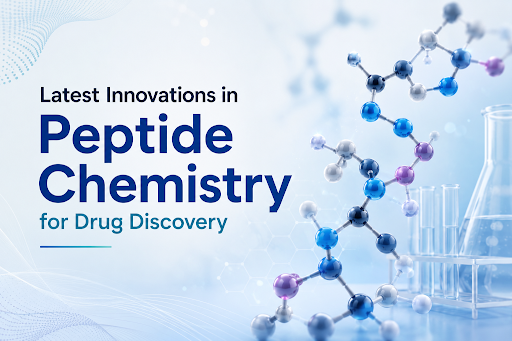
Drug discovery has progressed tremendously over the last decade, and one notable development in drug discovery is the rising popularity of peptide-based drugs due to their superior specificity, low toxicity, and capacity to interfere with complicated biological systems. Due to the emergence of new drugs that are both safe and effective, peptide chemistry has emerged as one of the major areas of research in drug discovery. Innovations in peptide synthesis, automation, analytical methods, and Peptide Coupling Reagents have enabled chemists to synthesize peptides much more efficiently than before. Such innovations not only make research by pharmaceutical companies easier but also help in improving peptide consistency and scalability.
Why Peptide Chemistry Is Transforming Modern Drug Discovery
Peptides lie somewhere between small-molecule drugs and biologics. They offer the advantage of interacting with biological targets, which are often hard to reach using other types of drugs. Therefore, they are useful in drug development for treating diseases like cancer, metabolic diseases, autoimmune diseases, infectious diseases, and neurodegenerative diseases.
With the growing number of peptide-based therapies needed, the current trend of developing synthesis methods that decrease the cost, increase the yield, and ease the complexity of the production process is widely observed. The development in peptide chemistry makes the achievement of these goals possible.
Smarter Peptide Synthesis Through Automation
Automation has become one of the main tools of the modern development of peptide chemistry. Modern peptide synthesizers are capable of conducting highly precise and repeatable reactions using minimal amounts of human involvement.
Some of the advantages of automated peptide synthesis include:
- Faster peptide library production for screening
- Higher reproducibility between different batches
- Low risk of human errors
- Reaction conditions optimization
- Increased productivity of research laboratories
In addition, scientists have the opportunity to test various peptide sequences rapidly in order to find the most promising compounds.
Green Chemistry Is Changing Laboratory Practices
The problem of sustainability has become one of the key issues in pharmaceutical research. Conventional synthesis of peptides requires high amounts of hazardous chemicals and produces a lot of chemical waste.
To solve this problem, the researchers adopt green approaches, such as:
- Environmentally-friendly solvents
- Decreased consumption of solvents
- Energy-efficient conditions of reactions
- Recyclable catalysts
- Minimization of waste generation
These advancements not only decrease the negative effects on the environment but also minimize expenses and maintain the same product quality.
Better Reagents Are Improving Reaction Efficiency
One of the greatest advancements in peptide chemistry is the constant improvement of Peptide Coupling Reagents. These reagents have a significant impact on the effectiveness, purity, and success of chemical reactions that result in the creation of peptide bonds.
Some of the advantages of modern systems include:
- Higher efficiency of reactions
- Less chances of racemization
- Purer reaction profile
- Less by-product formation
- Higher sensitivity to certain amino acids
This makes it possible to synthesize peptides with more complex structures while preserving purity and high yield, making these advancements extremely useful in the pharmaceutical industry.
Artificial Intelligence Is Accelerating Peptide Design
Machine learning technology is increasingly being used in studies related to peptides. Rather than relying only on conventional hit-or-miss strategies, researchers are now able to predict peptide structure, optimize sequence, and assess the biological activity of peptides before peptide synthesis.
Artificial intelligence assists in drug discovery through:
- Stability prediction of peptides
- Identification of potential drugs
- Optimization of amino acid sequences
- Reduction of the experimental load
- Saving time for the drug development process
Combining computation tools with laboratory research speeds up decision-making and increases the efficiency of the drug development program.
High-Resolution Analytical Technologies Improve Quality
The use of modern analytical instruments has greatly improved peptide characterization. Peptide identity, purity, and structure can now be confirmed with very high precision.
Peptide characterization techniques include:
- High-performance liquid chromatography (HPLC)
- Liquid chromatography-mass spectrometry (LC-MS)
- Nuclear magnetic resonance (NMR)
- Amino acid analysis
- Circular dichroism spectroscopy
These technological advances guarantee that synthesized peptides meet stringent criteria in terms of quality before entering biological assessment or further clinical trials.
Expanding Applications of Peptide Therapeutics
The increasing versatility of peptide technology has paved the way for new possibilities within different medical fields.
Peptide therapies are currently being used for the following purposes:
- Targeted cancer therapies
- Antimicrobial peptides
- Hormone replacement treatments
- Diabetes management
- Cardiovascular therapies
- Vaccine development
- Precision medicine
Scientists are currently investigating multifunctional peptides that can transport drugs to diseased sites.
Advances in Solid-Phase Peptide Synthesis
Solid-phase peptide synthesis (SPPS) is still one of the key methods of synthesizing peptides. Recent developments have substantially enhanced the method.
Some recent advances include:
- High loading resins
- Quicker deprotection techniques
- Microwave-assisted peptide synthesis
- Flow-through peptide synthesis
- Enhanced purification techniques
These developments have made it possible for the synthesis of longer and more complex peptides in a much more efficient manner compared to what was done before.
Overcoming Challenges in Complex Peptide Manufacturing
While there has been impressive progress in peptide synthesis, there are still some technical challenges that remain, especially when producing long peptides.
These challenges include:
- Sequenced aggregation problems
- Challenging coupling reactions
- Degradation of peptides
- Scalability and consistency
- Cost-effective large-scale manufacturing
Ongoing improvements in science, engineering, instrumentation, and other areas continue to solve these technical challenges, making it easier for peptide drugs to be commercialized from laboratory settings.
Driving the Future of Pharmaceutical Innovation
The future of peptide chemistry certainly appears very promising indeed, with ongoing technological advancements leading to revolutionary changes in drug discovery processes. Some of the important factors that will shape the pharmaceutical industry and its future include automation, artificial intelligence, green chemistry, advanced technology, and very effective Peptide Coupling Reagents, among others, which are ensuring the development of medicines that are safe and effective for mankind.
For those firms that are in search of premium quality Peptide Coupling Reagents, pharmaceutical intermediates, chemicals, and facilities of custom synthesis, Azaricta Research Labs is an ideal place where reliable assistance can be gained for meeting all their research and manufacturing needs. Owing to its commitment towards delivering excellence in quality and innovations, Azaricta Research Labs continues to be among the leading choices of researchers and pharmaceutical firms alike.