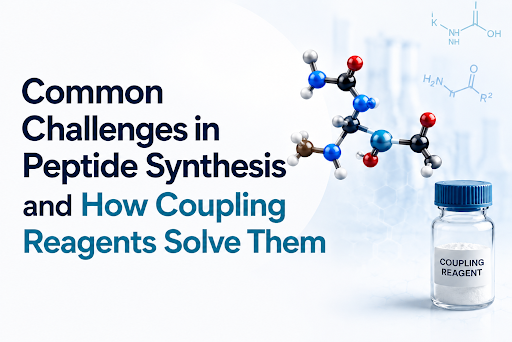
Peptide synthesis is highly relevant for the pharmaceutical industry, biotechnological research, diagnostic purposes, and academic research labs. Regardless of whether one is developing medicinal peptides or synthesizing research compounds, each stage of the process requires great precision. However, it is not always easy to obtain the desired high-quality peptides, as researchers might be troubled by problems related to incomplete chemical reactions, impurities, racemization, or poor yields. Such difficulties may influence the effectiveness of the end-product; hence, the need for optimizing the process of synthesis arises. This is where Peptide Coupling Reagents become an important part of successful peptide synthesis, helping researchers improve reaction efficiency while maintaining product quality.
Why Peptide Synthesis Can Be Challenging
Peptide synthesis entails the creation of links between amino acids through the formation of peptide bonds. While this principle is quite straightforward, controlling the reaction conditions during synthesis is rather complicated and requires precision. Small inefficiencies during the coupling stage may lead to contamination with by-products, which become difficult to eliminate at a further stage.
With an increase in the complexity of peptide sequences, there may be an occurrence of many challenges related to the process of synthesis. Such factors as steric hindrances, reactivity of amino acids, humidity sensitivity, and reaction time have an impact on the success of the process.
Being aware of some of these challenges will allow researchers to choose proper approaches to deal with them.
Incomplete Coupling Reactions
The challenge that occurs quite frequently during peptide synthesis is the lack of complete reaction between the amino acids. If the reaction is not completed properly, some unreacted amino groups stay on the growing peptide chain.
It may lead to several difficulties, including:
- Lower overall peptide yield
- Formation of deletion sequences
- Increased purification requirements
- Reduced batch consistency
Incomplete coupling is more frequent in cases where large amino acids are used or where long peptide chains limit the accessibility of reactive sites.
Optimization of the reaction conditions and use of appropriate coupling methodology can enhance the efficiency of coupling.
Racemization During Peptide Formation
The preservation of the proper stereochemistry of amino acids is essential since any alteration may change the biological activity of the peptide.
Racemization refers to the change of an amino acid from its natural state to its mirror state while it undergoes an activation or coupling process. It is an unwanted chemical reaction that can be detrimental to:
- Biological function
- Structural integrity
- Drug development studies
- Analytical reproducibility
Some amino acid residues are more sensitive compared to others, and therefore, it is critical to be able to choose the right reagents when dealing with such peptide sequences.
Formation of Side Products
Apart from the desired peptide bond formation, there might be several reactions that compete with this process.
Some of the most common of them are as follows:
- Hydrolysis due to moisture
- Over-activation of amino acid residues
- Formation of inactive intermediates
- Cyclization reactions
- Peptide chains aggregation
Each undesired reaction decreases the effectiveness of synthesis and increases purification time and costs.
Planning the reaction helps to avoid such difficulties from the very beginning.
Steric Hindrance in Complex Peptides
The larger the peptide chain becomes, the more challenging it is to access its amino group because of steric hindrances. The problem is especially obvious in peptides that contain bulky amino acids or have a highly structured sequence.
As a result of steric hindrance, the following may occur:
- Slow reaction rates
- Inefficient coupling
- Wasteful use of reagents
- Several recoupling cycles
Scientists usually deal with this problem through the optimization of parameters of reactions, better chemistry of activation, and solvent systems.
How Modern Coupling Chemistry Improves Peptide Synthesis
Modern peptide synthesis depends upon the development of specific activation chemistry, which is aimed at providing effective bond formation without any side reactions. Quality Peptide Coupling Reagents activate the carboxyl group and provide a controlled reaction of amino acids.
Their benefits are:
- Faster coupling reactions
- Improved peptide yield
- Reduced racemization
- Better use with automated peptide synthesizers
- Low side product formation
- Better reproducibility across batches
Such innovations become especially important in the synthesis of long peptide sequences, challenging amino acid sequences, or research-quality peptides that require high purity.
Selecting the Right Coupling Strategy
There is no one-fits-all procedure for all peptide synthesis procedures. Scientists usually decide on the type of coupling based on several criteria.
Among others, they take into account:
- Peptide sequence length
- Amino acid types used
- Desired peptide purity
- Size of synthesis
- Phase of synthesis (solid-phase vs solution phase)
- Compatibility with purification procedures
Finding the balance between reaction efficiency and peptide quality will help to avoid unnecessary expenses and increase laboratory productivity.
Best Practices for Better Peptide Synthesis Results
Though the use of coupling reagents is crucial for the success of the synthesis, there are other practices that will make scientists' work more effective.
They include:
- Using fresh, high-purity reagents
- Maintaining moisture-free reaction conditions
- Monitoring reaction progress carefully
- Optimizing reaction temperature and time
- Performing test syntheses before large-scale production
- Following standardized synthesis protocols
A combination of these practices, along with appropriate reagents, will greatly increase experiment reproducibility.
Supporting Reliable Research Through Quality Chemical Solutions
The successful synthesis of peptides is possible only with the availability of high-quality materials in the laboratory, along with good reagents. Scientists in the pharmaceutical field, biotech sector, life sciences research, and academia find it advantageous to use high-quality chemicals that are capable of ensuring precise research results. Apart from Peptide Coupling Reagents, there are other products like peptide synthesis building blocks, protecting reagents, specialty research chemicals, analytical reagents, and custom chemical solutions used in laboratories to facilitate complex research processes.
For laboratory scientists looking for reliable research chemicals with quality assurance, Azaricta Research Labs is one organization that provides research chemicals that will help in supporting the synthesis of peptides. Their commitment to quality, reliability, and innovation makes them a dependable choice for researchers aiming to achieve reproducible and high-performance results.