Chemical reactions often involve reactants that do not dissolve well in the same solvent. When this happens, bringing the reactants together efficiently can become a challenge. Phase transfer catalysts help address this problem by facilitating the transfer of certain reactive species between different phases, allowing reactions to proceed more effectively.
For researchers and manufacturers looking for a Phase Transfer Catalysts Supplier in India, understanding how these catalysts work is important for selecting suitable materials for research, process development, and chemical manufacturing. Phase transfer catalysis has applications across organic synthesis, pharmaceutical chemistry, and other areas where controlled chemical reactions are required.
What Are Phase Transfer Catalysts?
A phase transfer catalyst, commonly referred to as a PTC catalyst, is a substance that helps transfer a reactive species from one phase of a reaction mixture into another phase where it can participate in a chemical reaction.
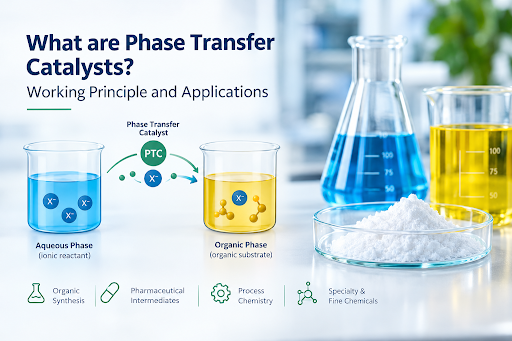
Many chemical reactions involve two phases, such as an aqueous phase and an organic phase. Certain reactants or ions may preferentially remain in one phase because of their chemical properties. Without assistance, their interaction with a reactant in another phase can be limited.
A phase transfer catalyst helps overcome this separation. It interacts with the reactive species and enables it to move into the phase containing the other reactant. This can make the reaction more practical under suitable reaction conditions.
How Does Phase Transfer Catalysis Work?
The working principle of phase transfer catalysis is based on facilitating the movement of reactive species between immiscible or partially miscible phases.
For example, a reaction may contain an organic compound in an organic solvent and an ionic reactant in an aqueous phase. Because the two reactants are present in different phases, their direct interaction may be inefficient.
The catalyst helps transport the reactive ionic species into the organic phase. Once there, the species can react with the organic substrate. The catalyst can then return to the original phase or participate in another transfer cycle.
The process can be understood through these basic steps:
- Reaction components are separated: Reactants may be present in different phases because of their solubility.
- Catalyst interacts with the reactive species: The PTC catalyst associates with the ion or reactive component.
- Transfer takes place: The catalyst facilitates movement of the reactive species into the phase containing the substrate.
- Reaction occurs: The transferred species reacts with the substrate.
- Catalyst is regenerated: The catalyst can participate in another transfer cycle.
This mechanism makes phase transfer catalysis useful when direct mixing of reactants does not provide an efficient reaction pathway.
Why Are PTC Catalysts Important in Organic Synthesis?
The use of a PTC catalyst can help make reactions involving different phases more manageable. Instead of requiring every reactant to be soluble in a single reaction medium, phase transfer catalysis can help reactive species reach the phase where the desired reaction takes place.
This approach can be useful in organic synthesis, particularly for reactions involving ionic reagents and organic substrates. Depending on the reaction, phase transfer catalysis may also provide practical benefits such as simpler reaction conditions and improved interaction between reactants.
However, the suitability of a particular catalyst depends on the reaction, substrate, solvent system, temperature, concentration, and other process conditions. Catalyst selection should therefore be based on the specific chemistry involved rather than treated as a one-size-fits-all decision.
Common Types of Phase Transfer Catalysts
Different classes of compounds can perform phase transfer functions. The choice depends on the chemistry of the reaction and the species that needs to be transferred.
Common categories include:
- Quaternary ammonium salts: Frequently used for transferring anionic species between phases.
- Quaternary phosphonium salts: Another class of ionic compounds that can function as phase transfer catalysts.
- Crown ethers: These can interact with certain metal cations and influence their availability in an organic phase.
- Other specialised catalyst systems: Specific reactions may require specialised structures designed around the reactants and reaction conditions.
Each catalyst class has different chemical characteristics, so researchers generally evaluate compatibility, reaction conditions, selectivity, and the desired outcome before making a selection.
Applications of Phase Transfer Catalysts
Phase transfer catalysis has relevance across several areas of chemical research and manufacturing. It is particularly useful when a reaction involves components that are distributed across different phases.
Some important areas include:
Pharmaceutical and Chemical Research
Phase transfer catalysis can support synthetic routes used to prepare organic compounds and pharmaceutical intermediates. Since pharmaceutical research often involves multi-step synthesis, suitable catalytic systems can be considered during route development.
Organic Synthesis
One of the major areas associated with PTC catalyst technology is organic synthesis. Phase transfer methods can be used in reactions where an ionic reagent needs to interact effectively with an organic substrate.
Process Chemistry
Phase transfer catalysts can also be relevant during process development, where researchers evaluate reaction efficiency, practicality, and scalability. Selecting a suitable catalyst system can be part of developing a workable synthetic route.
For organisations seeking a Phase Transfer Catalyst Supplier in India, Azaricta Labs offers Phase Transfer Catalysts as part of its broader portfolio of catalysts and specialty chemical products. Its website also highlights applications across organic synthesis, process chemistry, and industrial chemical manufacturing.
Factors to Consider When Selecting a Phase Transfer Catalyst
Choosing a suitable catalyst requires consideration of the reaction rather than simply selecting the most commonly used option. Important factors can include:
- Nature of the substrate and reactants
- Type of reactive ionic species involved
- Organic and aqueous phases used in the reaction
- Solvent compatibility
- Reaction temperature
- Catalyst concentration
- Desired selectivity and reaction outcome
- Requirements for laboratory or larger-scale applications
Researchers should also review the available technical and safety information before handling any chemical material.
Azaricta Labs and Its Chemical Product Portfolio
Azaricta Labs provides a broad portfolio of research chemicals, specialty chemicals, catalysts, pharmaceutical intermediates, building blocks, and other chemistry products. Its website lists Phase Transfer Catalysts as a dedicated product category alongside catalysts, phosphine ligands, boronic products, heterocycles, peptide coupling reagents, and other materials used in chemical research and development.
The company also provides custom synthesis support for selected research and commercial requirements, with expertise spanning organic synthesis, peptide chemistry, catalysts, specialty chemicals, battery materials, and pharmaceutical intermediates. Its product portfolio is available from milligram to bulk scale, depending on the product category.
Making Phase Transfer Chemistry More Practical
Phase transfer catalysis provides a useful approach for reactions where important reactants are separated between different phases. By facilitating the movement of reactive species, these catalysts can help enable interactions that may otherwise be inefficient.
For pharmaceutical research, process chemistry, and other synthetic applications, the right catalyst should be selected according to the reaction system and technical requirements. For organisations seeking a Phase Transfer Catalysts Supplier in India, Azaricta Labs can be the best option to opt for, with its dedicated Phase Transfer Catalysts portfolio, wider range of research and specialty chemicals, and custom synthesis capabilities supporting diverse chemistry requirements.